集群版PostgreSQL
集群版PostgreSQL
Section titled “集群版PostgreSQL”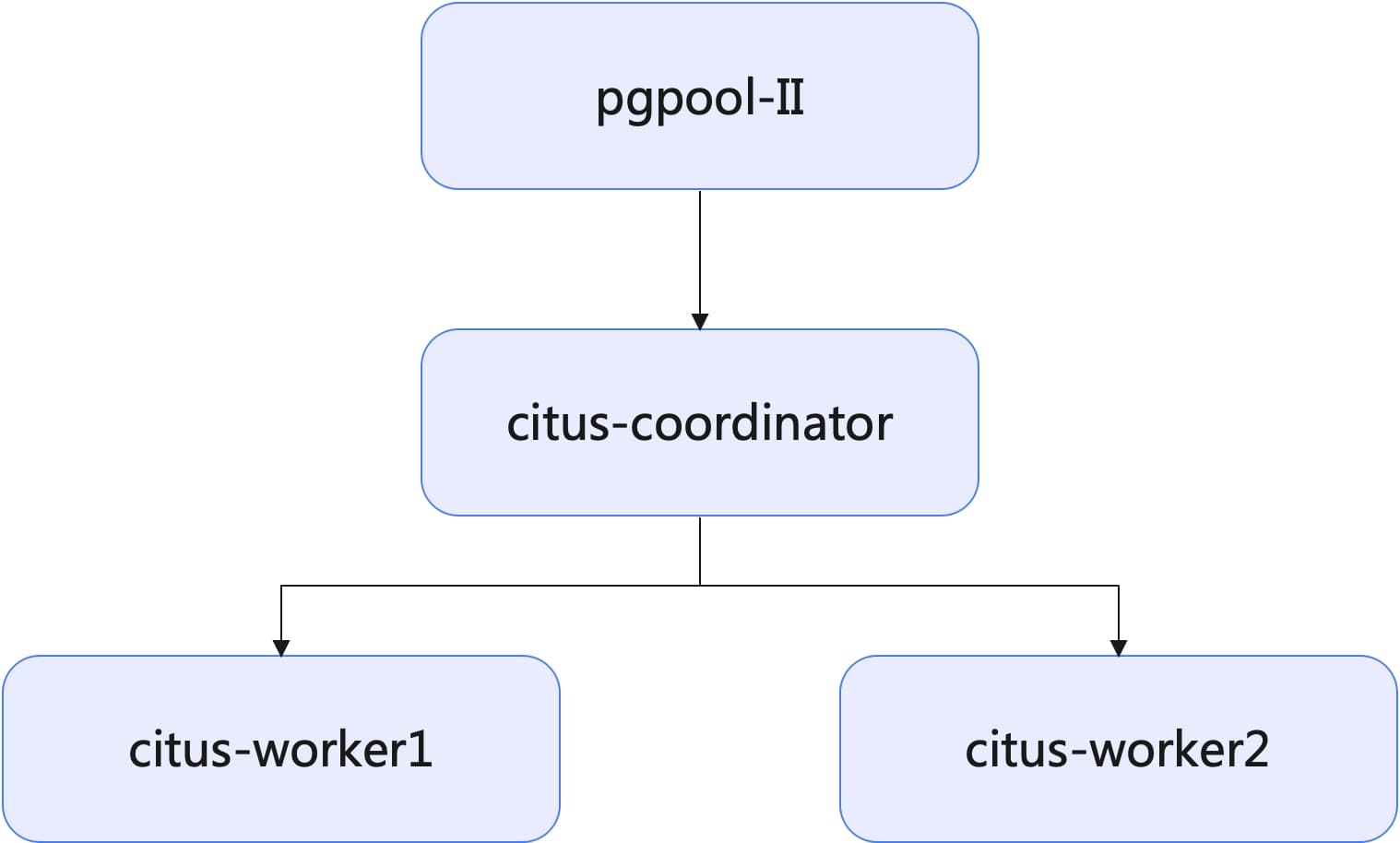
对应的IP(这样下面有所对照):
| IP | 主机名 | 组件 |
|---|---|---|
| 172.19.2.15 | hadoop-metal-001 | citus-coordinator / pgpool-II |
| 172.19.2.16 | hadoop-metal-002 | citus-worker1 |
| 172.19.2.17 | hadoop-metal-003 | citus-worker2 |
初始化Swarm管理节点
Section titled “初始化Swarm管理节点”docker swarm init --advertise-addr 172.19.2.15这个命令将会创建一个Swarm集群,并将当前主机设置为管理节点。初始化成功后,它会输出一个加入集群的命令,该命令用于其他工作节点。
加入Swarm工作节点
Section titled “加入Swarm工作节点”在另外两台主机上,均执行刚才的输出的加入集群的命令:
docker swarm join --token SWMTKN-1-xxxxxxxxx 172.19.2.15:2377创建overlay网络
Section titled “创建overlay网络”docker network create -d overlay --attachable citus-overlay-network验证网络和节点
Section titled “验证网络和节点”# 查看网络docker network ls
# 查看节点docker node ls将在三台机器上创建相应的数据目录:
mkdir -pv /mnt/data_2/citus-data/{coordinator,worker1,worker2}部署配置(deployment.yml):
version: '3.8'
services:  citus-coordinator:    image: citusdata/citus:latest    environment:      POSTGRES_PASSWORD: "123456"    networks:      - citus-overlay-network    ports:      - "5432:5432"    volumes:      - /mnt/data_2/citus-data/coordinator:/var/lib/postgresql/data  # 将数据目录挂载到卷    deploy:      replicas: 1      placement:        constraints:          - node.role == manager
  citus-worker1:    image: citusdata/citus:latest    environment:      POSTGRES_PASSWORD: "123456"    networks:      - citus-overlay-network    volumes:      - /mnt/data_2/citus-data/worker1:/var/lib/postgresql/data  # 将数据目录挂载到卷    deploy:      replicas: 1      placement:        constraints:          - node.hostname == hadoop-metal-002  # 确保这是唯一的主机名
  citus-worker2:    image: citusdata/citus:latest    environment:      POSTGRES_PASSWORD: "123456"    networks:      - citus-overlay-network    volumes:      - /mnt/data_2/citus-data/worker2:/var/lib/postgresql/data  # 将数据目录挂载到卷    deploy:      replicas: 1      placement:        constraints:          - node.hostname == hadoop-metal-003  # 确保这是唯一的主机名
  pgpool:    image: bitnami/pgpool:latest    environment:      - PGPOOL_BACKEND_NODES=0:citus-coordinator:5432      - PGPOOL_SR_CHECK_USER=postgres      - PGPOOL_SR_CHECK_PASSWORD=123456      - PGPOOL_ADMIN_USERNAME=admin  # 添加管理员用户名      - PGPOOL_ADMIN_PASSWORD=123456  # 添加管理员密码      - PGPOOL_POSTGRES_USERNAME=postgres  # 设置数据库管理员用户名      - PGPOOL_POSTGRES_PASSWORD=123456  # 设置数据库管理员密码(与 Coordinator 的相同)      - PGPOOL_PORT_NUMBER=9999    networks:      - citus-overlay-network    ports:      - "9999:9999"  # 默认 pgpool-II 端口    deploy:      replicas: 1      placement:        constraints:          - node.role == manager
networks:  citus-overlay-network:    external: true
启动:
docker stack deploy -c deployment.yml citus-stack停止:
docker stack rm citus-stack注册工作节点
Section titled “注册工作节点”如果前面没有自己挂载数据目录的话,直接运行下面的master_add_node函数就行了。但如果挂载了数据目录,集群启动后,需要做一些修改:分别修改worker1和worker2对应的数据目录的pg_hba.conf文件,哪些允许/禁止规则都删除掉,只加2条:
local all postgres trusthost all postgres 0.0.0.0/0 trust然后:
docker exec -it <container_id> psql -U postgres运行以重新加载配置:
SELECT pg_reload_conf();添加计算节点:
SELECT master_add_node('citus-worker1', 5432);SELECT master_add_node('citus-worker2', 5432);验证集群:
SELECT * FROM master_get_active_worker_nodes();创建分布式表来验证一下
Section titled “创建分布式表来验证一下”CREATE TABLE users (id bigserial, name text, email text);
SELECT create_distributed_table('users', 'id');查看分片和 Worker 节点的详细信息:
SELECT s.shardid, s.shardminvalue, s.shardmaxvalue, p.nodename, p.nodeportFROM pg_dist_shard sJOIN pg_dist_shard_placement p ON s.shardid = p.shardidWHERE s.logicalrelid = 'users'::regclass;在 Citus 集群中,每个数据库都是独立的,且每个数据库的分布式表和 Worker 节点配置也是独立的。这意味着在创建新的分布式数据库时,必须在所有 Worker 节点上创建相应的数据库。
因此,为了简化这个创建数据库的过程,可以创建一个数据库模板:
CREATE DATABASE template_citus;\c template_citusCREATE EXTENSION citus;当需要创建新数据库时,使用 template_citus 作为模板:
CREATE DATABASE new_db TEMPLATE template_citus;如果这个过程有说template_citus正在被使用,类似:ERROR: source database “template_citus” is being accessed by other user,那么可以先终止和template_citus相关的任务:
SELECT pg_terminate_backend(pid) FROM pg_stat_activity WHERE datname = 'template_citus' AND pid <> pg_backend_pid();更简单的镜像
Section titled “更简单的镜像”上述我们使用的是citus官方提供的镜像:citusdata/citus:latest,但我之所以要用集群版PostgreSQL,核心场景是用于GeoServer,其中主要用到的扩展用:PostGIS和pg_repack,因此研究一下干脆自定义一个镜像吧。过程比较简单,并且在此过程中,也学到了可以把模板数据库的创建放到初始脚本中。
Dockerfile参考:https://github.com/postgis/docker-postgis/blob/master/16-3.4/Dockerfile,在此基于上修改了一下:
FROM postgres:16-bullseye
LABEL maintainer="PostGIS Project - https://postgis.net" \      org.opencontainers.image.description="PostGIS 3.4.2+dfsg-1.pgdg110+1 spatial database extension with PostgreSQL 16 bullseye" \      org.opencontainers.image.source="https://github.com/postgis/docker-postgis"
ENV POSTGIS_MAJOR 3ENV POSTGIS_VERSION 3.4.2+dfsg-1.pgdg110+1
RUN sed -i 's/deb.debian.org/mirrors.ustc.edu.cn/g' /etc/apt/sources.list \      && apt update \      && apt install -y curl \      && apt-cache showpkg postgresql-$PG_MAJOR-postgis-$POSTGIS_MAJOR \      && apt install -y --no-install-recommends \           ca-certificates \           postgresql-$PG_MAJOR-postgis-$POSTGIS_MAJOR=$POSTGIS_VERSION \           postgresql-$PG_MAJOR-postgis-$POSTGIS_MAJOR-scripts \           postgresql-$PG_MAJOR-repack \      && curl https://install.citusdata.com/community/deb.sh > /tmp/add-citus-repo.sh \      && bash /tmp/add-citus-repo.sh \      && apt -y install postgresql-16-citus-12.1 \      && rm -rf /var/lib/apt/lists/*
RUN mkdir -p /docker-entrypoint-initdb.d && echo 4COPY ./initdb-postgis.sh /docker-entrypoint-initdb.d/10_postgis.shCOPY ./update-postgis.sh /usr/local/bin对initdb-postgis.sh和update-postgis.sh 中补充了citus的扩展:
#!/bin/bash
set -e
# Perform all actions as $POSTGRES_USERexport PGUSER="$POSTGRES_USER"
# Create the 'template_postgis' template db"${psql[@]}" <<- 'EOSQL'CREATE DATABASE template_postgis IS_TEMPLATE true;EOSQL
# Load PostGIS into both template_database and $POSTGRES_DBfor DB in template_postgis "$POSTGRES_DB"; do  echo "Loading PostGIS extensions into $DB"  "${psql[@]}" --dbname="$DB" <<-'EOSQL'    CREATE EXTENSION IF NOT EXISTS postgis;    CREATE EXTENSION IF NOT EXISTS postgis_topology;    -- Reconnect to update pg_setting.resetval    -- See https://github.com/postgis/docker-postgis/issues/288    \c    CREATE EXTENSION IF NOT EXISTS fuzzystrmatch;    CREATE EXTENSION IF NOT EXISTS postgis_tiger_geocoder;    CREATE EXTENSION IF NOT EXISTS pg_repack;    CREATE EXTENSION IF NOT EXISTS citus;EOSQLdone
#!/bin/sh
set -e
# Perform all actions as $POSTGRES_USERexport PGUSER="$POSTGRES_USER"
POSTGIS_VERSION="${POSTGIS_VERSION%%+*}"
# Load PostGIS into both template_database and $POSTGRES_DBfor DB in template_postgis "$POSTGRES_DB" "${@}"; do echo "Updating PostGIS extensions '$DB' to $POSTGIS_VERSION" psql --dbname="$DB" -c " -- Upgrade PostGIS (includes raster) CREATE EXTENSION IF NOT EXISTS postgis VERSION '$POSTGIS_VERSION'; ALTER EXTENSION postgis UPDATE TO '$POSTGIS_VERSION';
-- Upgrade Topology CREATE EXTENSION IF NOT EXISTS postgis_topology VERSION '$POSTGIS_VERSION'; ALTER EXTENSION postgis_topology UPDATE TO '$POSTGIS_VERSION';
-- Install Tiger dependencies in case not already installed CREATE EXTENSION IF NOT EXISTS fuzzystrmatch; -- Upgrade US Tiger Geocoder CREATE EXTENSION IF NOT EXISTS postgis_tiger_geocoder VERSION '$POSTGIS_VERSION'; ALTER EXTENSION postgis_tiger_geocoder UPDATE TO '$POSTGIS_VERSION';
CREATE EXTENSION IF NOT EXISTS pg_repack; CREATE EXTENSION IF NOT EXISTS citus; "done因为citus需要再postgresql.conf中增加一行配置:
shared_preload_libraries = 'citus'因此我们干脆自己重新准备一个干净的custom-postgresql.conf,比如:
shared_buffers = 8GB # 根据系统内存调整effective_cache_size = 12GB # 根据系统内存调整maintenance_work_mem = 1GB # 根据需求调整checkpoint_completion_target = 0.9wal_buffers = 16MB # 根据需求调整default_statistics_target = 100random_page_cost = 1.1work_mem = 32MB # 根据需求调整min_wal_size = 2GBmax_wal_size = 8GBmax_worker_processes = 256max_parallel_workers_per_gather = 8max_parallel_workers = 256max_parallel_maintenance_workers = 8max_connections = 512password_encryption = md5shared_preload_libraries = 'citus'listen_addresses = '*'log_timezone = 'Etc/UTC'datestyle = 'iso, mdy'timezone = 'Etc/UTC'default_text_search_config = 'pg_catalog.english'当然pg_hba.conf也可以准备一份新的,假设取名:custom-hba.conf:
local all postgres trusthost all postgres 0.0.0.0/0 trust最终整个deployment.yml就是:
version: '3.8'
services:  citus-coordinator:    image: postgis/postgis-citus:16-3.4    environment:      POSTGRES_DB: postgres      POSTGRES_USER: postgres      POSTGRES_PASSWORD: "123456"      PGDATA: /var/lib/postgresql/data/pgdata    networks:      - citus-overlay-network    ports:      - "5432:5432"    volumes:      - /mnt/data_2/citus-data/coordinator:/var/lib/postgresql/data  # 将数据目录挂载到卷      - /root/Applications/citus/custom-postgresql.conf:/etc/postgresql/postgresql.conf      - /root/Applications/citus/custom-hba.conf:/etc/postgresql/pg_hba.conf    command: ["postgres", "-c", "config_file=/etc/postgresql/postgresql.conf", "-c", "hba_file=/etc/postgresql/pg_hba.conf"]    deploy:      replicas: 1      placement:        constraints:          - node.role == manager
  citus-worker1:    image: postgis/postgis-citus:16-3.4    environment:      POSTGRES_DB: postgres      POSTGRES_USER: postgres      POSTGRES_PASSWORD: "123456"      PGDATA: /var/lib/postgresql/data/pgdata    networks:      - citus-overlay-network    ports:      - "15432:5432"    volumes:      - /mnt/data_2/citus-data/worker:/var/lib/postgresql/data  # 将数据目录挂载到卷      - /root/Applications/citus/custom-postgresql.conf:/etc/postgresql/postgresql.conf      - /root/Applications/citus/custom-hba.conf:/etc/postgresql/pg_hba.conf    command: ["postgres", "-c", "config_file=/etc/postgresql/postgresql.conf", "-c", "hba_file=/etc/postgresql/pg_hba.conf"]    deploy:      replicas: 1      placement:        constraints:          - node.hostname == hadoop-metal-002  # 确保这是唯一的主机名
  citus-worker2:    image: postgis/postgis-citus:16-3.4    environment:      POSTGRES_DB: postgres      POSTGRES_USER: postgres      POSTGRES_PASSWORD: "123456"      PGDATA: /var/lib/postgresql/data/pgdata    networks:      - citus-overlay-network    ports:      - "25432:5432"    volumes:      - /mnt/data_3/citus-data/worker:/var/lib/postgresql/data  # 将数据目录挂载到卷      - /root/Applications/citus/custom-postgresql.conf:/etc/postgresql/postgresql.conf      - /root/Applications/citus/custom-hba.conf:/etc/postgresql/pg_hba.conf    command: ["postgres", "-c", "config_file=/etc/postgresql/postgresql.conf", "-c", "hba_file=/etc/postgresql/pg_hba.conf"]    deploy:      replicas: 1      placement:        constraints:          - node.hostname == hadoop-metal-003  # 确保这是唯一的主机名
  pgpool:    image: bitnami/pgpool:latest    environment:      - PGPOOL_BACKEND_NODES=0:citus-coordinator:5432      - PGPOOL_SR_CHECK_USER=postgres      - PGPOOL_SR_CHECK_PASSWORD=123456      - PGPOOL_ADMIN_USERNAME=admin  # 添加管理员用户名      - PGPOOL_ADMIN_PASSWORD=123456  # 添加管理员密码      - PGPOOL_POSTGRES_USERNAME=postgres  # 设置数据库管理员用户名      - PGPOOL_POSTGRES_PASSWORD=123456  # 设置数据库管理员密码(与 Coordinator 的相同)      - PGPOOL_PORT_NUMBER=9999    networks:      - citus-overlay-network    ports:      - "9999:9999"  # 默认 pgpool-II 端口    deploy:      replicas: 1      placement:        constraints:          - node.role == manager
networks:  citus-overlay-network:    external: true
这个这样就简单了很多。
如何查看一个schema下的所有表哪些是分布式表,哪些不是分布式表
Section titled “如何查看一个schema下的所有表哪些是分布式表,哪些不是分布式表”SELECT t.table_schema, t.table_name, CASE WHEN p.logicalrelid IS NOT NULL THEN 'Distributed' ELSE 'Not Distributed' END AS distribution_statusFROM information_schema.tables tLEFT JOIN pg_dist_partition pON t.table_schema || '.' || t.table_name = p.logicalrelid::regclass::textWHERE t.table_schema = 'your_schema_name' -- 替换为您的schema名称 AND t.table_type = 'BASE TABLE';确保一个schema下的所有表都是分布式表:
DO $$DECLARE rec RECORD;BEGIN -- 获取指定 schema 下的所有表 FOR rec IN SELECT t.table_schema, t.table_name FROM information_schema.tables t WHERE t.table_schema = 'your_schema' AND t.table_type = 'BASE TABLE' LOOP -- 检查每个表是否是分布式表 IF NOT EXISTS ( SELECT 1 FROM pg_dist_partition WHERE logicalrelid = (rec.table_schema || '.' || rec.table_name)::regclass ) THEN -- 检查表中是否存在 osm_id 字段 IF EXISTS ( SELECT 1 FROM information_schema.columns WHERE table_schema = rec.table_schema AND table_name = rec.table_name AND column_name = 'osm_id' ) THEN -- 如果存在 osm_id 字段,转换为分布式表 RAISE NOTICE 'Converting table % to distributed with distribution key: osm_id', rec.table_schema || '.' || rec.table_name; EXECUTE 'SELECT create_distributed_table(''' || rec.table_schema || '.' || rec.table_name || ''', ''osm_id'');'; ELSE -- 如果表中不存在 osm_id 字段,跳过 RAISE NOTICE 'Table % does not have an osm_id column, skipping.', rec.table_schema || '.' || rec.table_name; END IF; ELSE RAISE NOTICE 'Table % is already a distributed table, skipping.', rec.table_schema || '.' || rec.table_name; END IF; END LOOP;END $$;